If you buy through our links, Amazon pays us a small commission at no extra cost to you. That’s how we keep the site running. How we choose.
Contents
Our top 3 picks
Stock checked on October 6, 2026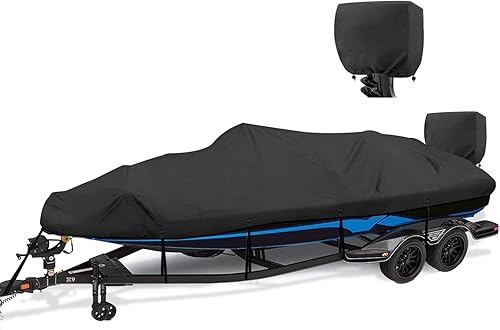

boat covers comparison, in stock
Boat Cover 16-18.5 ft, 1200D Waterproof V-Hull, Black
Boat Covers 17-19ft, 1200D Waterproof V-Hull, Black
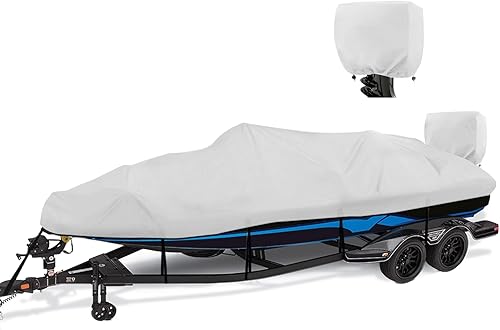
Boat Cover 16-18.5 ft, 1200D Waterproof V-Hull, Gray
Boat Cover 14-16 ft, 1200D Waterproof V-Hull, Black
Boat Cover 20-22 ft, 1200D Waterproof V-Hull, Black
Boat Covers 17-19ft, 1200D Waterproof V-Hull, Gray

Waterproof 20-22FT Boat Cover, 1200D Heavy Duty Trailerable Cover

Waterproof 17-19FT Boat Cover, 1200D Heavy Duty Trailerable Cover
BarcoEquipado score: combines the average rating and the number of buyer reviews on Amazon. No brand pays to be featured.
What a Boat Cover Should Do
A cover is not just a tarp: it shields upholstery from UV, stops rainwater from pooling in the cockpit, keeps off dust, bird droppings and salt spray, and cuts the cleanup at the start of the season. A poor cover does the opposite: it forms pockets where water sits, chafes the gelcoat or blows off in the first storm.
The models above are ranked from spec sheets and reviews. This guide gives you the criteria to decide, because a boat on a slip all year needs something very different from a runabout stored in a garage.
Fabric: Polyester, Acrylic or Breathable Membrane
| Fabric | Pros | Limits | Best for |
|---|---|---|---|
| 600D polyester with PU coating | Waterproof, light, affordable | Coating wears down in the sun | Winter storage on land, occasional use |
| Solution-dyed polyester | Far better UV resistance, holds color | Costs more | Boats in the water all year |
| Marine acrylic canvas | Breathes, stays cool, very durable | Not fully waterproof in heavy rain, usually custom | Permanent slip covering |
| Multi-layer breathable membrane | Waterproof and breathable at once | High cost | Demanding winter storage |
Look at the fabric weight: under about 6 oz per square yard (200 g/m²) a cover wears quickly; for long use choose 9 oz (300 g/m²) or heavier. Sealed seams and reinforcements at chafe points (bow, fenders, stanchions) matter as much as the cloth itself.
Sizing: Length, Beam and Hull Shape
Universal covers are sold in length and beam ranges. Measure your boat like this:
- The hull length from bow to stern, not counting a pulpit or platform if they stick out.
- The maximum beam at the widest point.
- The height from the keel (or trailer) to the tallest part you want to cover (windshield, T-top, folded bimini).
Pick the cover whose range includes your measurements with some margin: a short cover pulls tight, splits at the seams and comes off, while an oversized one flaps in the wind. As a rough guide, a 16 ft open boat with a 6.5 ft beam usually fits the "16-18 ft" size.
Watch out: a radar arch, a bow pulpit or a fixed bimini top completely changes the size. If your boat has tall accessories, look for a cover made for that configuration or order one custom.
Ventilation and Tie-Downs: What Prevents Mildew
A sealed cover with trapped moisture grows mildew and smells in the upholstery. Look for mesh vents, or use support poles that lift the canvas and create an air chamber. On cabin boats, ventilate the interior too.
The tie-down system decides whether the cover survives a storm. The ideal is straps with buckles under the hull, an elastic hem and, for a trailered boat, straps down to the axle. Covers with only an elastic hem lift as soon as a gust arrives.
Use Cases: On Land, on the Water or on the Trailer
- Winter storage on land: prioritize waterproofing and ventilation. Use a center support so rain runs off; more ideas in how to winterize a boat.
- On a slip or at a mooring: UV and salt resistance come first. This is where solution-dyed polyester or custom acrylic pays off most.
- Trailering: you need straps down to the trailer and a light fabric that does not balloon on the highway. Never tow with a storage cover.
- Covering only the cockpit or console: a partial cover costs less and is enough when the boat already has a top.
Installing and Caring for the Cover
Before covering, wash the boat with fresh water and let it dry: if you trap dirt and salt, the cover turns them into stains. Pad the chafe points with tape or foam sleeves, run the straps under the hull and tighten evenly.
While in use, check the cover after every storm. Wash it with water and mild soap (never bleach) and store it dry and folded. If it is very dirty, see our canvas cleaners so you do not damage the coating.
Tip: if a cover keeps blowing off, the fabric is rarely the problem; the straps are. Add one at the stern and another under the keel before you think about replacing the cover.
Common Buying Mistakes
- Buying by length alone, ignoring beam and the height of accessories.
- Choosing the cheapest cover for a boat that stays in the water all year; it will not last a season.
- Leaving no ventilation and covering a damp boat.
- Forgetting to protect chafe edges on the hull and hardware.
- Towing the trailer with a storage cover.
If you also need to cover the motor separately, see console and outboard covers.
Frequently asked questions
What size boat cover do I need?
Measure hull length from bow to stern, maximum beam and the height of any accessories you want to cover. Choose the cover whose range includes those numbers with a small margin. A tight cover splits at the seams, and an oversized one flaps in the wind.
What is the best fabric for a boat cover?
For occasional use or winter storage, coated 600D polyester is enough. If the boat sits in the water all year, solution-dyed polyester or marine acrylic holds up better against sun and salt.
Can a boat cover damage my boat?
Yes, if it traps moisture or chafes the gelcoat. Avoid that by ventilating, supporting the canvas on poles that create an air space and padding the chafe points. Always cover the boat clean and dry.
How do I stop my boat cover from blowing off?
Use straps with buckles that run under the hull or down to the trailer axle, in addition to the elastic hem. The more tie-down points, the less the canvas lifts. Check the tension after every storm.