If you buy through our links, Amazon pays us a small commission at no extra cost to you. That’s how we keep the site running. How we choose.
Contents
Our top 3 picks
Stock checked on October 6, 2026

boat fenders comparison, in stock
Seachoice Twin Eye Ribbed Boat Fender Kit - Includes a Pair of MFP Fender Lines, Multiple Sizes/Colors

Seachoice Twin Eye Ribbed Boat Fender Kit - Includes a Pair of MFP Fender Lines, Multiple Sizes/Colors
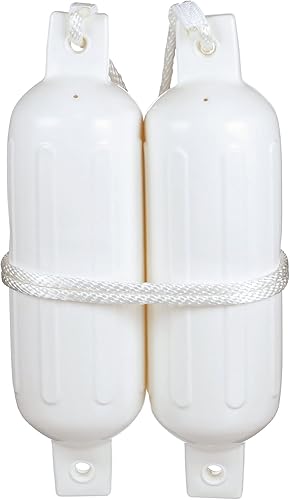
Seachoice Twin Eye Ribbed Boat Fender Kit - Includes a Pair of MFP Fender Lines, Multiple Sizes/Colors
Seachoice Twin Eye Ribbed Boat Fender Kit - Includes a Pair of MFP Fender Lines, Multiple Sizes/Colors
Extreme Max 3006.7201 BoatTector Inflatable Fender Value 2-Pack - 6.5" x 22", White
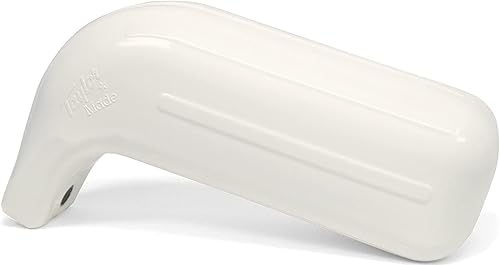
Taylor Made Products 31005 Low Freeboard Boat Fender, 5 x 14 inch, White

Affordura Boat Fender 4 Pack Boat Bumpers Fenders with 4 Ropes
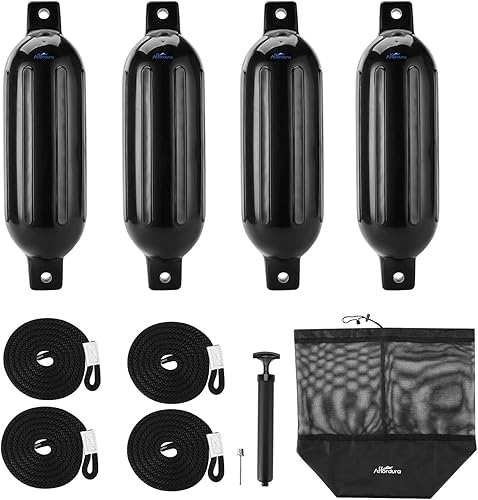
Affordura Boat Fender 4 Pack Boat Bumpers Fenders with 4 Ropes
BarcoEquipado score: combines the average rating and the number of buyer reviews on Amazon. No brand pays to be featured.
How to choose boat fenders
Three things decide the purchase: size (the most important), type for how you dock, and material quality. A small fender gives a false sense of security: it squirts out between hull and dock just when you need it. A big one is never too big.
Look at vinyl thickness, the quality of the inflation valve and the eyes at the ends, which are the usual failure points on cheap models.
Fender size chart by boat length
| Boat length | Cylindrical (diameter x length) | Ball (diameter) | Minimum per side |
|---|---|---|---|
| Up to 16 ft (5 m) | 4 x 16 in | 10 in | 2 |
| 16-23 ft (5-7 m) | 6 x 20-24 in | 12-14 in | 3 |
| 23-30 ft (7-9 m) | 7-8 x 24 in | 16 in | 3 |
| 30-36 ft (9-11 m) | 8-10 x 24-28 in | 18-22 in | 3-4 |
| 36-43 ft (11-13 m) | 10-12 x 30-32 in | 22-26 in | 4 |
| 43-52 ft (13-16 m) | 12 x 36-44 in | 26-30 in | 4-5 |
The chart is a guide for average-displacement boats in sheltered harbors. Go up a size if your boat is heavy for its length, you raft up with other boats or your marina gets surge.
Types of fenders
- Cylindrical with two eyes: the most versatile. With an eye at each end they hang vertically (floating dock) or horizontally (pilings and fixed docks).
- Cylindrical with a center hole: the line runs through an inner tube. Light and affordable, ideal for runabouts and boats up to about 30 ft.
- Ball fenders: lots of volume to protect flared bows, swim platforms or docks with a big height difference. They also work as marker buoys, as we cover in mooring and marker buoys.
- Flat and dock fenders: hang on the side or fix to the dock and do not roll. Bow fenders protect the stem when docking bow-in.
- Budget inflatable PVC fenders: reasonable for runabouts and occasional use, though with thinner vinyl and less durable valves.
How to hang fenders
- Hang them from a solid point such as a stanchion base or a rail, not the thin lifeline, using an adjustable knot like a clove hitch or a rolling hitch.
- Adjust the height so they sit at dock level or at the neighbor's hull, not at the waterline.
- Space them out: the biggest at the beamiest point of the boat and the rest on each side.
- If you dock stern-to, use two fenders aft and one or two forward.
Tip: in busy harbors, combine fenders with good dock lines and snubbers. Fenders absorb the knock, but the lines control the motion.
Inflating and care
Inflate fenders firmly but not to the maximum if they will sit in the sun: heat expands the air and can burst a seam. Check them often, since they lose pressure over time. A hand pump with a needle adapter is essential.
- Clean with fresh water and mild soap; avoid solvents that dry out the vinyl.
- If you are not using them, store slightly deflated and out of the sun.
- Fabric fender covers protect against chafe and stains and make docking more comfortable.
Common mistakes with fenders
- Hanging them too high or too low: they must sit between the hull and the dock.
- Leaving them hanging while underway: chafe and wind damage them.
- Using a line so thin that it saws through against the fender.
- Buying on price alone: a fender that pops mid-season costs more than a good one.
Warning: bring fenders aboard when you leave the dock. Underway they bang against the hull and can come loose or scratch the gelcoat.
Our team compares spec sheets, verified reviews and real-world criteria but does not physically test products. Always confirm dimensions and material on the listings above.
Frequently asked questions
What size fenders do I need for my boat?
As a guide, about 6 inch diameter cylindrical fenders for boats of 16 to 23 ft, 7 to 8 inch for 23 to 30 ft, and 8 to 10 inch for 30 to 36 ft. If you are between two sizes, choose the larger one.
How many fenders should I have?
At least three per side, and four or more on larger boats or if you raft up. It is a good idea to carry one larger spare as well.
Cylindrical or ball fenders?
Cylindrical fenders are the most versatile along a floating dock. Ball fenders offer more volume and do better on flared bows, swim platforms or high fixed docks.
How much should I inflate my fenders?
Enough to hold their shape and cushion, but not to the maximum. If they will sit in direct sun, leave them slightly softer so heat does not burst them.