If you buy through our links, Amazon pays us a small commission at no extra cost to you. That’s how we keep the site running. How we choose.
Contents
Anchor chain is the part of the rode that works hardest and gets the least attention. It adds weight so the pull on the anchor stays horizontal, it resists chafe against rock and shell, and if you have a windlass it has to fit the gypsy exactly. This guide covers what size and length to choose, how the chain types differ, and how to connect it to the anchor and the rope.
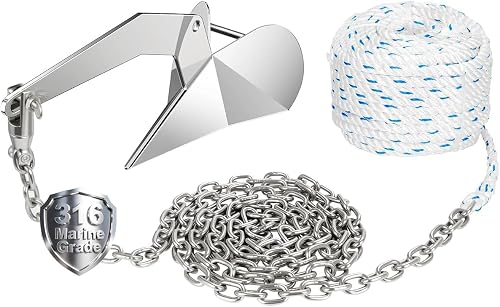
Quick answer: hot-dip galvanized steel chain, calibrated (ISO 4565 / DIN 766) if you have a windlass, in a size that matches your boat (about 1/4 in or 6 mm up to roughly 23 ft, 5/16 in or 8 mm up to about 40 ft), with at least one boat length of chain. If you can carry more, do: 100 to 150 ft of chain makes for far safer anchoring than the bare minimum.
Chain size and length by boat length
As a rule of thumb, the full anchor rode (chain plus rope) should be at least five to seven times the water depth where you anchor, and many sailors want a total length of five times the boat length. The chain section should be at least as long as the boat. Rules vary by country, so check what applies to your vessel. This table is a practical guide:
| Boat length | Typical chain size | Minimum chain | Total rode (min.) | Recommended chain |
|---|---|---|---|---|
| 16 ft (5 m) | 1/4 in (6 mm) | Can be mostly line | 80 ft | 15-30 ft of 1/4 in + rope |
| 20 ft (6 m) | 1/4 in (6 mm) | Can be mostly line | 100 ft | 30-50 ft of 1/4 in + rope |
| 23 ft (7 m) | 1/4 in (6 mm) | 23 ft | 115 ft | 65-100 ft of 1/4 in |
| 26 ft (8 m) | 1/4-5/16 in (6-8 mm) | 26 ft | 130 ft | 100-130 ft of 5/16 in |
| 30 ft (9 m) | 5/16 in (8 mm) | 30 ft | 150 ft | 130-165 ft of 5/16 in |
| 40 ft (12 m) | 5/16 in (8 mm) | 40 ft | 200 ft | 165-200 ft of 5/16 in |
| 50 ft (15 m) | 3/8 in (10 mm) | 50 ft | 250 ft | 200-260 ft of 3/8 in |
The "recommended" column is a guide for typical anchoring in 15 to 35 ft of water. With all the working rode in chain, the boat swings less, the anchor works better, and there's no risk of a rope being cut on a rock. For the anchor itself, see what size anchor do I need.
Weight and dimensions of calibrated chain
Approximate figures for short-link calibrated chain. Link pitch (the inside length of a link) decides whether it fits the gypsy, so always compare it with your windlass and chain data sheets:
| Size | Approx. pitch | Approx. weight | 100 ft | 200 ft |
|---|---|---|---|---|
| 6 mm (about 1/4 in) | 0.73 in | 0.54 lb/ft | 54 lb | 108 lb |
| 8 mm (about 5/16 in) | 0.94 in | 0.94 lb/ft | 94 lb | 188 lb |
| 10 mm (about 3/8 in) | 1.10 in | 1.5 lb/ft | 150 lb | 300 lb |
| 12 mm (about 1/2 in) | 1.42 in | 2.2 lb/ft | 220 lb | 440 lb |
Think about that weight in the bow: 150 ft of 3/8 in chain puts roughly 225 lb at the front of the boat, which changes the trim on small powerboats and sailboats. That's why lighter boats combine a length of chain with nylon rope.
Chain types: calibrated, long link and grades
Calibrated ISO 4565 / DIN 766
Short links with tight tolerances. It's the only chain that meshes properly with a windlass gypsy. If your boat has a windlass, or will have one, there's no alternative.
Long-link chain
Cheaper and lighter per foot. It suits boats without a windlass that haul a short length by hand next to the anchor. Don't use it with a windlass: long links jump off the gypsy.
Grade 30 and grade 40
Most recreational anchor chain is grade 30 (BBB or proof coil in the US). Higher grades, like G40 high-test, offer a higher working load for the same size, which sometimes lets you go down a size and save weight in the bow. Decide using the manufacturer's tables and check the gypsy fit.
Hot-dip galvanized, electro-galvanized or stainless
- Hot-dip galvanized: a thick zinc coating that protects for years. It's the standard for anchoring.
- Electro-galvanized: a very thin coating made for hardware stores. At sea it rusts quickly; avoid it, even though it's cheaper.
- 316 stainless: good looks, no staining and no regalvanizing. It costs a lot more and should be rinsed with fresh water. It's only worth it in 316; our guide to 304 vs 316 stainless explains why.
Compare models in our selection of anchor chain for boats.
How to connect chain to anchor, rope and boat
Anchor-to-chain connection
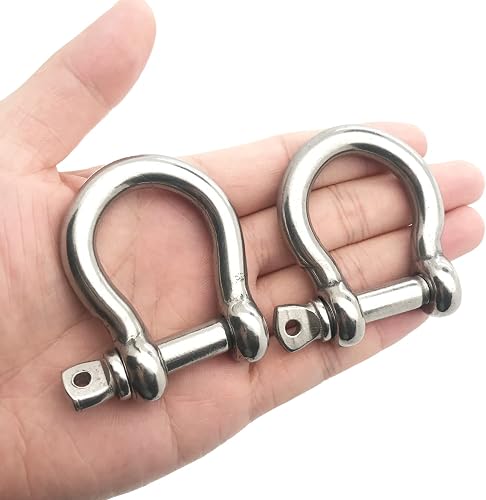
The most reliable option is a quality shackle one size up from the chain (for example, a 3/8 in shackle with 5/16 in chain), as long as the pin passes through the link. Secure the pin with stainless seizing wire so it can't unscrew. A swivel stops the chain from twisting during retrieval, but it must be good quality and not work sideways. More in anchor shackles and swivels.
Chain-to-rope splice
With a combination windlass gypsy, the rope is spliced directly to the chain so it passes without catching. If you haul by hand, an eye splice with a thimble and a shackle is a solid solution. Either way, the rope should be nylon for its stretch.
Securing to the boat
The bitter end in the anchor locker should be tied to the boat with a strong but cuttable line, never a shackle, so that you can cut the whole rode loose with a knife in an emergency.
Common mistakes with anchor chain
- Buying long-link chain for a windlass: it jumps and can damage the gypsy.
- Using electro-galvanized hardware-store chain instead of hot-dip galvanized.
- Fitting shackles smaller or weaker than the chain: the weakest link rules.
- Not marking the chain: without marks you don't know how much you've let out.
- Shackling the bitter end to the boat instead of using a cuttable line.
Watch out: always measure the real pitch of the chain with calipers before buying a windlass or gypsy. A difference of a couple of millimeters is enough to make the chain slip or jump.
Chain care and marking
- Mark the chain every 25 or 30 ft with colored cable ties or paint, or mark the links.
- Rinse the chain with fresh water now and then, and let the anchor locker vent and drain.
- Turn the chain end for end every couple of seasons: the first stretch, next to the anchor, takes the most wear.
- Inspect shackles and swivels at the start of the season, as part of your pre-departure checklist.
- Protect shackles and pins from corrosion with a marine anti-corrosion lubricant.
With the chain chosen, the next step is the anchor and, if the rode is long and heavy, an anchor windlass. To use it well, read how to anchor a boat step by step.
Recommended gear for this guide

Frequently asked questions
What size anchor chain do I need for my boat?
As a guide, 1/4 in (6 mm) up to about 23 ft, 5/16 in (8 mm) up to about 40 ft and 3/8 in (10 mm) up to about 60 ft. If you have a windlass, the chain must also match the gypsy. If you're between two sizes, pick the larger one if the bow weight allows it.
How much anchor chain should I carry?
At the very least, one boat length of chain and a total rode of about five times the boat length. In practice, 100 to 165 ft of chain on boats from 26 to 40 ft is ideal because it holds better and keeps the rope off the bottom.
Galvanized or stainless steel anchor chain?
Hot-dip galvanized is the standard: tough and affordable. 316 stainless looks better and doesn't stain, but costs a lot more. Avoid electro-galvanized hardware-store chain, which rusts very quickly at sea.
Can I use long-link chain with a windlass?
No. Long links don't mesh properly with the gypsy and the chain jumps, which can damage the windlass. With a windlass you need calibrated short-link chain with the exact pitch the gypsy manufacturer specifies.
How do I know how much chain I've let out?
Mark the chain every 25 or 30 ft with colored cable ties, paint or commercial markers, and note your color code. If you have an electric windlass, you can add a chain counter. That way you always know the exact scope.