If you buy through our links, Amazon pays us a small commission at no extra cost to you. That’s how we keep the site running. How we choose.
Contents
Our top 3 picks
Stock checked on October 6, 2026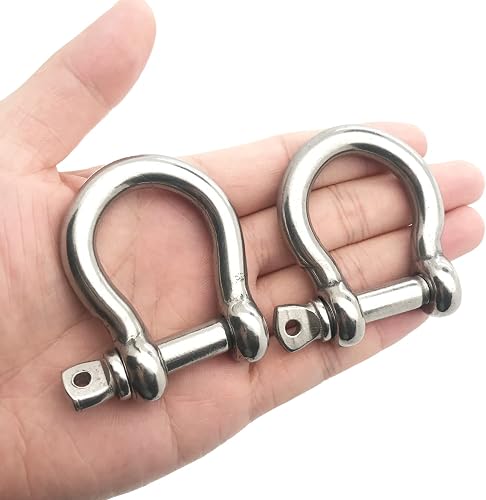


anchor shackles and swivels comparison, in stock
2 Pcs 3/8 Inch Screw Pin Anchor Shackle, 304 Stainless Steel Shackles,10 mm
Hulless 2 Pcs 3/8 Inch 304 Stainless Steel D Ring Shackles 10 mm Screw Pin Anchor Shackle for Traction Steel Wire, 10 mm
MarineNow 316 Stainless Steel Marine Bow Shackle with Oversized Screw Pin

SHONAN 1/2" Large Bow Shackle, Heavy Duty D Ring Shackle, Marine Grade Stainless Steel Boat Anchor Kit Screw Shackle…

SHONAN 1/4" Small Bow Shackles, Marine Grade D Ring Shackle, 6 Pcs Stainless Steel Shackles Screw Shackles for Chain or…

SHONAN 3/8" Bow Shackles, Heavy Duty D Ring Shackle Marine Grade, 2 Pcs Stainless Steel Boat Anchor Kit Large Screw…
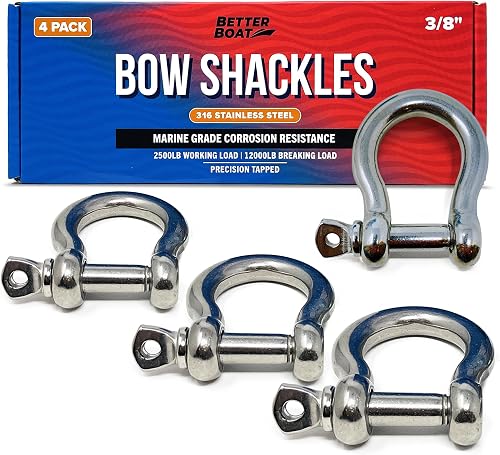
Premium Stainless Steel D-Ring Shackles, Marine Grade, 4-Pack, 3/8" Mini

316 Stainless Steel D-Ring Shackles, Marine Grade, 1/4", 5/16", 3/8", 1/2", Heavy Duty, Bow or Clevis Screw Pin Anchor…
BarcoEquipado score: combines the average rating and the number of buyer reviews on Amazon. No brand pays to be featured.
Choosing the right size
The basic rule is that the shackle should never be weaker than the chain, so most boaters fit one of the same size or one size up. Before you look at breaking loads, two physical checks: the pin has to fit through the last chain link and through the eye of the anchor shank.
| Chain | Recommended shackle | Typical boat length |
|---|---|---|
| 1/4 in. (6 mm) | 1/4 to 5/16 in. | Up to 25 ft |
| 5/16 in. (8 mm) | 5/16 to 3/8 in. | 26 to 40 ft |
| 3/8 in. (10 mm) | 3/8 to 7/16 in. | 40 to 60 ft |
| 1/2 in. (12 mm) | 1/2 to 9/16 in. | Over 60 ft |
This is a rough guide: the chain size you need depends on the anchor and the conditions. See our guide to anchor chain.
Shackle types
Straight or D shackle
Strongest for its size and least likely to deform. A good fit for light to medium chain when space allows.
Bow or anchor shackle
A wider bow takes loads that do not pull in a straight line. The usual choice for joining chain to an anchor with a large eye.
Screw pin or bolt-and-nut pin
A bolt-and-nut pin is moused with wire and easy to inspect. A screw pin is quicker at first but can seize with salt. For anchoring, what matters is that the pin cannot turn on its own.
Swivels: when they make sense
A swivel stops the chain twisting when the anchor spins on the way up. It helps the anchor arrive straight at the roller, which is why many people fit one. Know what you are buying:
- It is one more potential failure point, and a cheap swivel is the first thing to break under a sideways snatch.
- It should be 316 stainless or forged steel with a working load at or above that of your chain.
- Many cruisers fit a shackle between the swivel and the anchor so the swivel is never loaded sideways.
Warning: a swivel that looks like good stainless but has no load marking or part number is a gamble. If you cannot confirm the working load from the listing, pick another one.
316 stainless or galvanized
A high-strength galvanized shackle usually carries more load than a stainless one of the same size, and costs less. It loses its coating with wear and rusts over time, but that is easy to see and easy to replace. 316 stainless does not rust or stain, though it wears faster against chain. Avoid 304 stainless on ground tackle: it pits in salt water. If your chain is galvanized, a galvanized shackle also avoids galvanic corrosion between different metals. More on materials in anchor chain.
Rigging it step by step
- Check that the pin passes through the last link and the anchor eye without forcing.
- Tighten the pin fully with a tool, then back off a quarter turn to line up the hole.
- Thread stainless or monel seizing wire through the pin hole and around the shackle body, with two or three turns.
- Finish the wire ends so there are no sharp tips to cut lines or hands.
Tip: a UV-resistant zip tie is a stopgap, but replace it every season. Wire lasts for years.
Inspection and common mistakes
- Fitting a shackle smaller than the chain because it "goes in easier".
- Skipping the mousing: vibration backs the pin out and the chain separates.
- Reusing a shackle with a bent pin or an oval eye.
- Not checking the joint at the start of the season.
At the start of each season, lay the chain out in the sun and take the shackle apart to check the threads and pin. Replace it if you see pitting, deformation, or visible wear on the body. And if you are unsure which anchor fits your boat length, review what size anchor you need.
Frequently asked questions
What shackle size for 5/16 in. chain?
Usually the same size or one size up, so 5/16 or 3/8 in., as long as the pin passes through the link and the anchor eye. The shackle should never be weaker than the chain, so compare the working load of both.
Do I need a swivel between anchor and chain?
No, it is not essential. It helps keep the chain from twisting and lets the anchor come up straight to the roller, but it adds a failure point. If you fit one, use a quality 316 stainless model and keep it from loading sideways.
Stainless or galvanized shackle?
High-strength galvanized usually holds more and costs less; 316 stainless resists rust and looks cleaner. Both work if the quality is there. Avoid 304 stainless on ground tackle.
How do you secure a shackle pin?
Tighten it fully and mouse it with stainless or monel wire through the pin hole and around the shackle body. A UV-resistant zip tie works as a temporary fix but should be checked every season.