If you buy through our links, Amazon pays us a small commission at no extra cost to you. That’s how we keep the site running. How we choose.
Contents
A well-equipped fishing boat is not the one carrying the most gear. It is the one with what you need within reach when the bite turns on: a fish finder that shows where the fish are, rods secured in solid holders, a cooler to keep the catch, and a clear deck to work on. This guide ranks equipment by priority for a skiff, center console or RIB roughly 14 to 23 feet (4 to 7 m) long.
Short answer: start with a GPS fish finder, two to four stainless rod holders, a hard cooler, a landing net and a knife. Then add ground tackle sized for your depth and a VHF radio. Everything else can wait until next season.
Electronics: fish finder, GPS and VHF
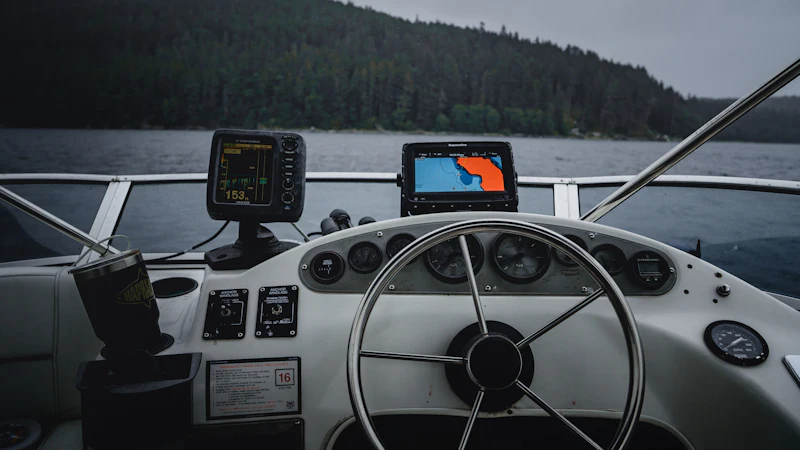
The fish finder is the most important fishing tool on the boat. It shows the bottom profile, water temperature and returns from fish or baitfish, and with built-in GPS you can save waypoints (reefs, ledges, wrecks) and go back to them accurately.
What screen size you need
On a small boat, a 4 to 5 inch screen is enough. If you want charts and a view of the coastline while you fish, a chartplotter combo with sonar at 7 inches or larger is easier to read, but it needs a power supply and a place to mount it. Full buying criteria are in GPS fish finders for boats.
No installation: portable fish finders
On inflatables, kayaks or rental boats, a portable fish finder that you cast out or fix with a suction cup and that sends data to your phone makes sense. They are inexpensive and quick to use, but have less range and rely on the wireless link and your phone battery.
Communications
A VHF radio is the standard way to call for help after a breakdown and to follow weather broadcasts, and it is essential anywhere beyond a couple of miles from shore. On a small boat, a waterproof floating handheld is enough; if you are unsure, read fixed vs handheld VHF.
Deck: rod holders, cooler and working space
Your deck should let you move around with a rod in hand without tripping. Before buying anything, measure the space and decide where each item goes.
| Boat length | Rod holders | Cooler size |
|---|---|---|
| Up to 16 ft (5 m) | 2 on the stern gunwale | 20 to 30 qt |
| 16 to 21 ft (5 to 6.5 m) | 2 to 4 on the gunwales plus a travel rod rack | 30 to 50 qt |
| Over 21 ft (6.5 m) | 4 to 6 on the gunwales and a rack on the T-top | 50 qt or built-in livewell |
Rod holders
Choose rod holders made of 316 stainless steel with fasteners of the same material; cheap steel holders rust within a season. If you are unsure about alloys, read stainless 304 vs 316. Flush-mount holders are cleaner and sturdier, while clamp-on models can move around depending on the technique.
Cooler
A well-insulated hard cooler keeps ice for a full day and doubles as a seat. Strap it down so it does not slide in a chop. Keep one section for fish and another for food and drinks.
Landing net, knife and bait board
A landing net with a telescoping handle saves fish that would otherwise be lost beside the hull. A short stainless knife and a non-slip bait board finish the work area. Carry gloves and long-nose pliers so you can unhook fish safely.
Rods, reels and tackle
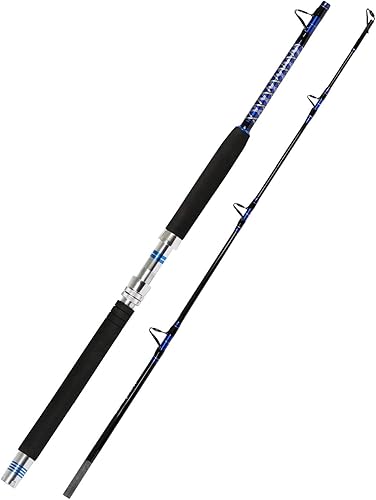
On a boat you fish short distances and mostly vertically, so shorter, sturdier rods work better than the ones used from shore. As a guide, 6 to 8 ft rods suit bottom fishing and light trolling, with reels that hold plenty of line and have a smooth drag. The technique decides: jigging is not trolling, and neither is bottom fishing with a sinker.
- Bottom and reef fishing: medium-heavy rod, reel with plenty of line and strong braid.
- Trolling: flexible rod, reel with a consistent drag, lures or spoons.
- Spinning and jigging: fast, light rods and spinning reels.
See the options in fishing rods and add a pair of polarized sunglasses, which let you see below the surface and protect your eyes from hooks and glare.
Anchoring to fish
Bottom fishing means anchoring in deeper water than a typical cove, so your rode has to be longer. As a rule of thumb, use a scope of 3:1 to 5:1 with chain, and more with rope or in wind. On a fishing boat, a reliable anchor and enough chain matter more than any gadget.
An anchor windlass is welcome above roughly 20 ft, especially if you retrieve the anchor alone. If you are unsure about sizing, see what anchor you need and how to anchor step by step.
Watch out: anchoring over rock to fish is the most common way to lose an anchor. Rig a trip line with a float so you can recover it if it fouls.
Safety: what you cannot skip
Fishing means a lot of time stopped, sometimes alone and far from port. The minimum kit is:
- Life jackets worn, not stowed: automatic inflatable life jackets are compact and do not get in the way when casting. Choose US Coast Guard approved models.
- VHF within reach, with the distress channel in mind.
- Engine cut-off lanyard attached to the outboard.
- Flares, a fire extinguisher and a first-aid kit in an accessible place.
- Navigation lights checked, in case the return trip runs late.
Review the rest in safety equipment and do not forget the engine: an outboard with up-to-date maintenance is the best insurance. Many anglers carry a small auxiliary motor to get home if the main engine fails. Always check your state's rules on required equipment and on fishing licenses.
Common mistakes when equipping a fishing boat
- Mounting the transducer where water is turbulent: readings become erratic at speed.
- Buying cheap, untreated steel rod holders that rust and stain the gelcoat.
- Cluttering the deck with accessories: open space is also safety.
- Heading out without a fishing license or without knowing size limits and bag limits.
- Anchoring with too little scope for the real depth and expected wind.
- Forgetting the battery: a fish finder, VHF and lights running for hours need a healthy battery.
After fishing: cleaning and upkeep
Salt, blood and bait residue punish a boat more than the cruising itself. Rinse the deck with fresh water when you finish, especially rod holders, hardware and reels, and dry the cooler thoroughly so it does not smell. Flush the engine with fresh water following the manufacturer instructions and check the condition of your lines and ground tackle. A pass with a gelcoat-specific cleaner removes stains before they set.
Store rods unstrapped and without tension, back off the drag on your reels and rinse lures. Ten minutes on this at the dock avoids expensive repairs mid-season.
What to buy, in order
- Life jackets, VHF and basic safety gear.
- GPS fish finder or portable unit.
- Rod holders and cooler.
- Landing net, knife, bait board.
- Ground tackle sized for your fishing grounds.
- Extras: trolling motor, deck lights, livewell.
If you are still shopping for a boat, read what first boat to buy first, and to plan the yearly budget, how much it costs to own a boat.
Recommended gear for this guide


Frequently asked questions
What equipment does a fishing boat need?
A GPS fish finder to read the bottom and mark spots, rod holders on the gunwales, a cooler for fish and bait, a landing net and knife, ground tackle matched to your depth, a VHF radio and the safety gear required where you boat.
What fish finder should I buy for a small fishing boat?
For a boat of 14 to 20 ft, a GPS fish finder with a 4 to 5 inch screen covers the essentials: bottom, fish, temperature and saved waypoints. If you want charts and a bigger screen, look at a 7 inch chartplotter combo. Portable units are an alternative when you have no wiring.
Where should I put rod holders on my boat?
On the stern and side gunwales, flush-mounted or bolted to a solid surface, for trolling and bottom fishing, plus a travel rack on the T-top or bow. 316 stainless steel handles the marine environment better than 304 or non-anodized aluminum.
Do I need a fishing license to fish from a boat?
In most states, saltwater anglers need a license or a registry, and there are size limits, bag limits and protected areas that vary by state. A boating certificate does not replace it, so check your state wildlife or marine fisheries agency before you go.
How much anchor rode do I need for fishing?
As a rule of thumb, a scope of 3:1 to 5:1 of the water depth when using chain, and more with rope or in strong wind. Remember to count the height of the bow above the water when you calculate it.