If you buy through our links, Amazon pays us a small commission at no extra cost to you. That’s how we keep the site running. How we choose.
Contents
Our top 3 picks
Stock checked on October 6, 2026


boat hooks comparison, in stock
Telescoping Boat Hook Pole, Push Pole with 3/4" Thread Screw End, Docking

EXTEND-A-REACH Boat Hook for Docking with Telescoping Extension Pole

Shurhold Telescoping Boat Hook for Docking with Non-Slip Grip

CROOKED CREEK Trac Outdoors Crooked Creek Telescoping Boat Hook - Allows You to Reach Further - Extends from 32-inches…
EVERSPROUT Telescoping Boat Hook | Floats, Scratch-Resistant, Sturdy Design | Durable & Lightweight, 3-Stage Anodized…

EVERSPROUT Telescoping Boat Hook | Floats, Scratch-Resistant, Sturdy Design | Durable & Lightweight, 3-Stage Anodized…
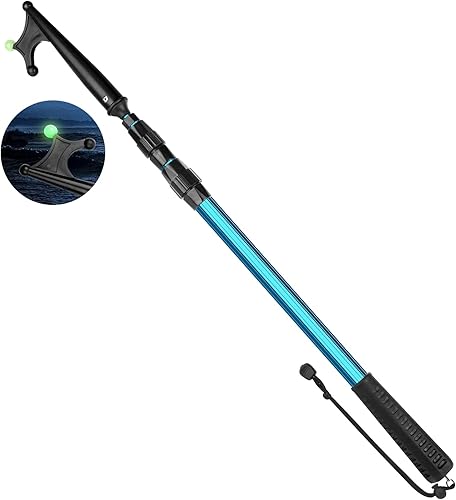
SANLIKE Telescopic Boat Hook, Floating Push Pole for Docking, 2.58-6.66Ft
BarcoEquipado score: combines the average rating and the number of buyer reviews on Amazon. No brand pays to be featured.
How to choose a boat hook
A boat hook does three jobs: picking up a mooring pennant or dock line when you arrive, fending your boat off an obstacle, and retrieving anything that goes overboard. Four details separate a good one from a frustrating one.
- Useful length. It has to reach the water from wherever you stand on deck, with room to extend your arm. On low-freeboard boats 5 to 6 ft is fine; on tall-bow sailboats, 8 to 10 ft.
- Weight and flotation. If it goes over the side, it should float. Hollow aluminum and fiberglass or carbon do; solid wood does too, but needs more upkeep.
- Head. It must catch a ring, a pennant, or a stanchion without slipping, and have a blunt end for pushing without scarring the gelcoat.
- Saltwater resistance. Nylon or 316 stainless fittings, and an anodized or coated tube.
Types of boat hook
Fixed
No moving parts, so nothing to fail. The right choice for small boats where it can lie along the gunwale.
Telescoping
Shortens to stow in a locker or the cockpit. The weak spot is the locking mechanism: cheap plastic ones fill with salt and slip just when you lean on them. Look for sturdy twist-lock or lever-lock collars.
Multi-purpose
Some heads unscrew so you can fit a deck brush or a retrieval attachment. Handy if one pole does several jobs, though it adds a bit of play.
| Type | Advantage | Drawback | Best for |
|---|---|---|---|
| Fixed aluminum | Strong and light | Takes up space | Powerboats and cruisers |
| Telescoping | Stows compactly | Delicate locks | Small sailboats and dinghies |
| Fiberglass or carbon | Very light, floats | Costs more | Frequent use |
| Wood | Classic look | Upkeep | Traditional boats |
Using it during docking
- Have it ready before you arrive: on deck within reach, not buried in a locker.
- To grab a mooring pennant or a dock line, approach into the wind or current and at nearly zero speed.
- Hook it and pull toward you, not out to the side; pulling with the boat still moving can put you in the water.
- To fend off, push with the blunt end and avoid levering against the hull.
Warning: never use a boat hook to stop a boat that is coming into a dock too fast. It will bend or snap, and you will lose your balance. That is what fenders and well-handled lines are for.
Maintenance
Rinse with fresh water after sailing, especially the telescoping locks, and dry it before stowing. Once a season, check the tube for dents and the head for cracks. A little silicone grease on the threads keeps them from seizing.
Where to stow it and what else to check
The best boat hook is the one within reach when you need it. On small powerboats and sailboats it usually hangs along the side deck in two rubber or stainless clips; on bigger boats, in a long locker off the passageway. Avoid clips that force you to unclip it with two hands.
Look at tube thickness too: a very thin tube is light but bends when you haul on a wet, heavy line. For dock lines on a boat over 26 ft, a tube around 1 to 1.25 in. is safer. And check that the end cap on the far end is not brittle plastic, because it takes the most knocks against the dock.
Common mistakes
- Buying one too short: if it will not reach the ring, it is useless.
- Stowing it below deck where you cannot grab it in a hurry.
- Choosing one that sinks and losing it the first time it drops.
- Using it as a punt pole to shove the boat along in a strong current.
Tip: tie a short floating line with a loop to the end so you can hang it from your wrist or a stanchion. See also dock lines and essential boating knots for each maneuver.
Frequently asked questions
What length boat hook do I need?
It depends on your freeboard and where you stand when docking. Small boats usually do well with 5 to 6 ft; sailboats from 30 to 40 ft with 6 to 10 ft. A telescoping model lets you adjust for each maneuver.
Aluminum or fiberglass boat hook?
Anodized aluminum is cheaper and good enough for most boaters. Fiberglass and carbon are lighter and float, which helps if you use it often or one-handed. Both hold up to salt if you rinse them.
Should a boat hook float?
It is not required, but it is a smart feature. If it falls in with a current running, a floating hook can be recovered; a heavy solid one is gone within seconds.
What is the boat hook head for?
The hook catches rings, pennants, and stanchions. The blunt end lets you push off without damaging the hull, and some heads rotate or detach to take other attachments.