If you buy through our links, Amazon pays us a small commission at no extra cost to you. That’s how we keep the site running. How we choose.
Contents
Our top 3 picks
Stock checked on October 6, 2026


electric air pumps comparison, in stock
AIRHEAD Air Pump, 12v, AHP-12H, Yellow and Black

AIRBANK Paddle Board Pump Electric 20PSI The Puffer Pro, Portable SUP Pump, Dual-Stage Inflation & Auto-Off Air Pump…
WOW Sports Electric Air Inflator, Air Pumps for Inflatables, Towables and Others, Comes with DC Power Adapter and Cord…
OutdoorMaster Shark 2 High Pressure SUP Pump, Electric Air Pump 20 PSI
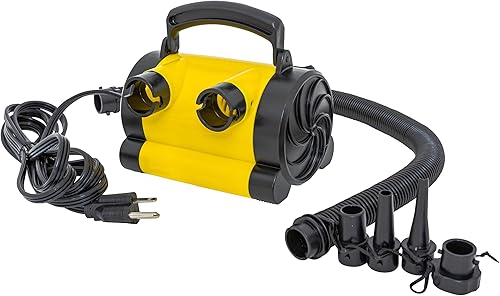
Airhead AHP-120 Kwik Tek Air Pump Canister (120-Volt), Yellow/Black
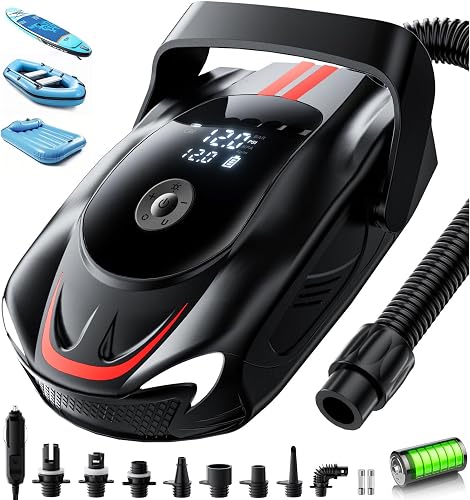
Electric Paddle Board Pump, 22PSI Rechargeable 12000mAh SUP Pump, Theer Stage Inflation/Deflation, Automatic Power-Off…

Hydrohero Electric Paddle Board Pump, 20 PSI Rechargeable SUP Pump

20PSI Electric Paddle Board Pump, Smart Rechargeable SUP Pump with DC 12V Car Connector, Inflation and Deflation Air…
BarcoEquipado score: combines the average rating and the number of buyer reviews on Amazon. No brand pays to be featured.
How to choose an electric air pump
An electric pump is one of the most appreciated accessories when you own an inflatable dinghy, an inflatable kayak or a paddle board. With a foot or hand pump you can spend 10 or 15 minutes and arrive worn out; with an electric one, the time drops to 3 to 8 minutes and the effort is almost nothing.
Not every pump suits everything. The three figures that matter are maximum pressure (PSI or bar), airflow and power source. First check the working pressure of what you'll inflate, then choose the pump.
Pressure and flow: what each product needs
Low-pressure items such as tubes, floats or dinghy floors need a large volume of air at low pressure. Paddle boards and kayaks with drop-stitch floors require much more pressure and therefore a two-stage pump.
| Product | Working pressure | Recommended pump type |
|---|---|---|
| Towables and floats | 1-4 PSI (0.1-0.3 bar) | Low-pressure, high-flow pump |
| Inflatable dinghies | 3-4 PSI (0.2-0.3 bar) | Low-pressure pump; two-stage pumps work too |
| Inflatable kayaks | 2-4 PSI in tubes, up to 15 PSI in floors | Two-stage or high-pressure |
| Paddle boards | 12-15 PSI (0.8-1.0 bar) | High-pressure two-stage electric pump |
Tip: if you inflate both boards and kayaks, choose a two-stage pump with a gauge. The first stage moves a lot of air at low pressure, and the second climbs to the final pressure.
Power source: 12 V, battery or wall plug
- 12 V cigarette-lighter socket or battery clamps: the usual choice aboard. Plug into the console socket or the house battery. Check that the cable is long and the fuse is the right rating.
- Built-in rechargeable battery: handy on the beach or in the dinghy, with no cables. Look at the run time in number of inflations.
- 120 V AC: useful at the marina or at home, but no use aboard without an inverter.
- Dual-power: works on 12 V and on mains power; the most versatile if you also use the pump ashore.
If you plan to use the pump often from the boat's batteries, a lithium battery gives better performance than lead-acid, and the pump doesn't lose power as voltage drops.
Features that make a difference
- Digital gauge with auto shut-off: set the pressure and the pump stops on its own. It prevents over-inflation, the most expensive mistake.
- Deflate function: reversing the airflow empties the inflatable in a minute and gets it ready to pack.
- Interchangeable nozzles: for Boston, screw-in, bicycle-style or mattress valves. Check it includes the ones you use.
- Long cord and handle: it seems minor, but with 10 feet of cable and a carry handle you save a lot of hassle.
- Thermal protection: a pump that shuts off when it overheats lasts much longer.
Watch out: small electric pumps aren't designed to run non-stop. If you inflate several items in a row, let it cool for a few minutes between them.
Real-world inflation times and power draw
As a reference, a two-stage electric pump inflates an 11-foot (3.3 m) paddle board in 5 to 8 minutes and a tandem kayak in about 5 minutes. An 8 to 10 foot (2.5 to 3 m) dinghy fills in 3 to 5 minutes with a low-pressure pump. These are rough figures: hot air, altitude and battery condition stretch them. If your battery is small, check the amps the pump draws and always allow about 20% headroom on the fuse in the cable.
Use, maintenance and common mistakes
- Seat the nozzle properly: if it leaks air at the valve, the job takes twice as long.
- Don't exceed the inflatable's maximum pressure. In the heat, pressure rises on its own, so stop slightly under.
- Dry the pump after using it by the sea. Salt on the connector and motor causes corrosion, and a corrosion-inhibitor spray helps.
- Keep hoses and nozzles in the pump's own bag.
- Carry a hand pump as a backup: if the battery or fuse fails, it saves the day. With a patch kit, you can also fix punctures (how to repair an inflatable boat).
The most common mistake is buying a low-pressure pump for a paddle board, or a high-pressure one with no auto shut-off for a dinghy, and ending up with a blown seam.
Frequently asked questions
What electric pump do I need for a paddle board?
A high-pressure electric pump able to reach 15 PSI (1 bar), preferably two-stage and with a gauge and auto shut-off. Low-pressure pumps won't give the board the stiffness it needs.
Can I use the same pump for a dinghy, a kayak and a board?
Yes, if it is two-stage and has the right nozzles. You use the first stage for the dinghy and the kayak tubes, and the high-pressure stage for the board and drop-stitch floors.
Does a 12 V pump drain the battery?
A typical pump draws 10 to 20 amps for a few minutes. For one or two inflations that isn't a problem with a healthy house battery, but avoid running it with the engine off if the battery is low.
What is auto shut-off for?
You set the pressure you want and the pump stops when it reaches it. It prevents over-inflating and damaging seams or valves, and lets you walk away while it fills.