If you buy through our links, Amazon pays us a small commission at no extra cost to you. That’s how we keep the site running. How we choose.
Contents
Our top 3 picks
Stock checked on October 6, 2026
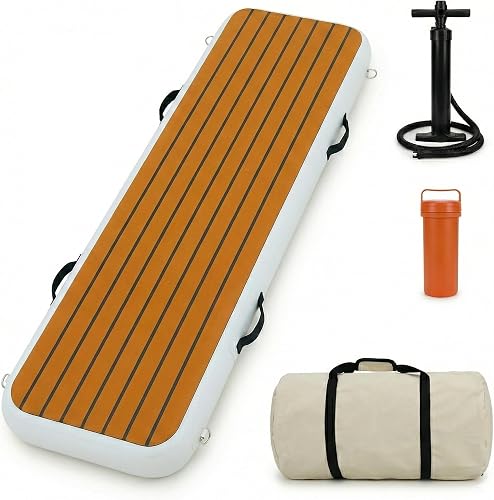

boat gangways comparison, in stock
10ft Inflatable Gangway for Yachts & Boats, Durable Dock Gangway with Non-Slip Surface, Portable and Space-Saving…
10FT×3FT Inflatable Gangway,Heavy Duty Boat Boarding Platform

6.6'x2'x6 Inflatable Gangway Sport Boats Yacht Dock Water Platform Boat Dock
6.6 ft Inflatable Gangway for Boats & Yachts, 500 lb Non-Slip EVA Dock-to-Boat Boarding Ramp, Reinforced PVC Floating…

6.6ft Inflatable Gangway for Boats and Yachts, Inflatable PVC Boat Floating Dock, Easy Setup for Marine Use
BarcoEquipado score: combines the average rating and the number of buyer reviews on Amazon. No brand pays to be featured.
How to choose a gangway for your boat
In Mediterranean marinas and in many European harbors, boats tie up stern-to, which leaves a gap between the swim platform and the dock that you have to cross safely. In the U.S., a boarding plank is more common on boats that anchor or beach bow-to, but the logic is the same: this piece of gear is how your crew, guests, kids and older passengers get on and off every day. A poorly chosen gangway bounces, slips or comes up short when the tide or wind moves the boat.
These are the criteria that actually matter:
- Length: measure from the mounting point at the stern to the dock edge with the boat tied up the way you normally leave it, then add 16 to 24 inches (40 to 60 cm) so the end rests solidly on the dock.
- Weight capacity: always follow the manufacturer's rating. The longer the span, the less load the center of the plank carries.
- Weight of the gangway: if one person handles it, every pound counts. Aluminum and carbon beat teak and wood.
- Non-slip surface: wet, or barefoot, grip matters more than looks.
- Wheels at the dock end: they let the gangway follow the boat's movement instead of dragging.
Tip: measure with the boat loaded and the fenders in place. With the stern lower in the water, or the boat pushed off the dock by wind, the real gap can be bigger than the one you measured dry.
Types of gangway: folding, telescoping and rigid
Most recreational boats use one of three designs:
Folding, two sections
The most common. It folds in half, stows in a locker or along the gunwale, and sets up in seconds. It is stiff when open, but watch the center hinge and its locking mechanism.
Telescoping
Adjusts length precisely and takes little space, which helps if you change marinas and docking styles often. It has more moving parts (tubes, pins, locks) that you should rinse with fresh water and check every season.
One-piece rigid
The simplest and cheapest to maintain, but you need somewhere to store it. Common on small boats and short docks.
Hydraulic or electric gangways built into the platform are convenient, but they belong on larger yachts and need professional installation.
Materials and length by boat size
Material sets the weight, the upkeep and the feel underfoot:
- Aluminum: the best all-rounder. Light, does not rot and needs almost no upkeep.
- Teak or slatted wood: the most elegant, with good grip barefoot, but heavier and in need of oil or regular cleaning.
- Carbon fiber: the lightest and stiffest. The price only pays off on large boats or racing yachts.
- Plastic or composite: budget-friendly and fine for occasional use, with a lower weight rating.
As a rough guide for length:
| Boat length | Typical gangway length |
|---|---|
| 20 to 30 ft (6 to 9 m) | 5 to 6.5 ft (1.5 to 2 m) |
| 30 to 40 ft (9 to 12 m) | 6.5 to 8 ft (2 to 2.5 m) |
| 40 to 50 ft (12 to 15 m) | 8 to 10 ft (2.5 to 3 m) |
| Over 50 ft (15 m) | 10 ft (3 m) or more, often custom |
If the dock is fixed and there is a big height difference between the dock and the platform, go longer so the slope is not too steep. A steep ramp is awkward and slippery when wet.
Mounting and dock safety
The usual setup is a pivot pin that drops into a stainless socket bolted to the stern or swim platform, so the gangway can swing. That fitting carries load every time someone steps aboard, so it should be through-bolted with a backing plate, just like a deck cleat.
To board safely:
- Tie a safety line from the gangway to the boat so it cannot fall in the water if it pops out of its socket.
- Rig a taut line handrail between two stanchions if kids or older passengers come aboard.
- With tides or gusts, check your lines: good dock lines of the right length keep the stern from surging against the dock.
- Light up the end at night: most falls between boat and dock happen in the dark.
Warning: do not cross two people at once unless the gangway is rated for it, and never load it beyond the manufacturer's limit.
Care and common mistakes
A gangway lasts for years if you look after it. Rinse it with fresh water after each outing, especially hinges and wheels, and check pins, rivets and locks before the season. Wood needs oil or cleaning to keep from graying; aluminum needs a rinse and little else.
The mistakes we see most often when people buy:
- Choosing a short gangway that barely rests on the dock.
- Ignoring weight and ending up not wanting to put it out each day.
- Trusting a pivot bolted only to fiberglass, with no backing plate.
- Forgetting that on a floating dock the height difference changes with the waves.
Also check your boat fenders: if the stern rubs the dock, the gangway shifts the same way and boarding gets less safe.
Frequently asked questions
What length of gangway do I need for my boat?
Measure from the stern mounting point to the dock edge with the boat tied up as you normally leave it, then add 16 to 24 inches (40 to 60 cm) for a solid rest. On boats from 20 to 30 feet, 5 to 6.5 feet is usually enough; for 30 to 40 feet, 6.5 to 8 feet.
Aluminum, teak or carbon fiber gangway?
Aluminum is the best balance: light, rot-proof and almost maintenance-free. Teak looks better and grips well barefoot, but it is heavier and needs care. Carbon fiber is lightest and stiffest, but only pays off on large or racing boats.
How much weight can a boat gangway hold?
It depends on the model and the length: the longer the span, the less load the center can take. Always follow the manufacturer's rating, and do not cross with two people at once unless it is designed for that.
How do you attach a gangway to a boat?
Usually with a pivot pin that fits into a stainless socket fixed to the stern or swim platform, through-bolted with a backing plate. The other end rests on the dock, ideally on wheels, and a safety line helps if it ever pops out.