If you buy through our links, Amazon pays us a small commission at no extra cost to you. That’s how we keep the site running. How we choose.
Contents
Our top 3 picks
Stock checked on October 6, 2026

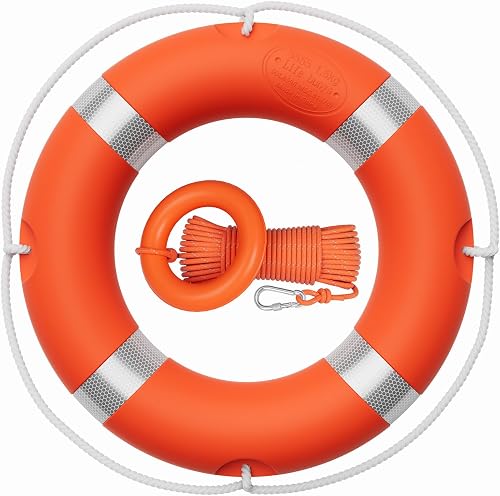
life rings and horseshoe buoys comparison, in stock
Taylor Made Coast Guard Approved Life Ring

23 inch/ 28 inch Boat Safety Throw Ring, Life Preserver Ring Buoy

23 inch/ 28 inch Boat Safety Throw Ring, Life Preserver Ring Buoy

Life Ring 23"/28" Boat Safety Throw Buoy with Reflective Tape & Grab Lines - Orange Life Rings for Boats,Includes Water…
2pcs Stainless Steel Marine Horseshoe Bracket Life Buoy Ring Holder with Plastic Mount
Tresbro 23"/28" Boat Safety Throw Ring with Water Floating Lifesaving Rope 50FT Set, Professional Life Ring and…
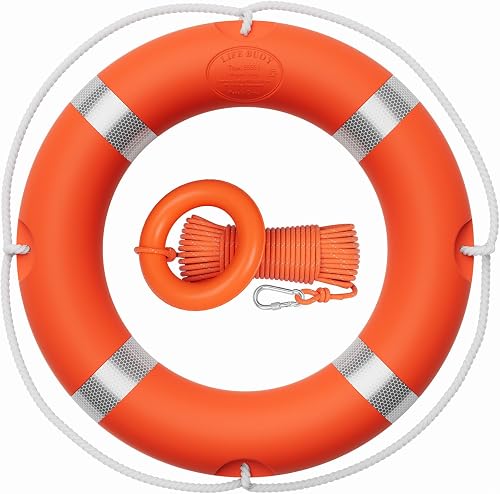
Tresbro 23"/28" Boat Safety Throw Ring with Water Floating Lifesaving Rope 50FT Set, Professional Life Ring and…

22 Inch Life Buoy Boat Safety Throw Ring Set, Outdoor Professional Throwable Flotation Device with 30 Meter Floating…
BarcoEquipado score: combines the average rating and the number of buyer reviews on Amazon. No brand pays to be featured.
Life ring or horseshoe buoy: the differences
Both are throwable rescue devices that give a person in the water something to hold while you maneuver to pick them up. The choice depends on your boat and where you can mount it.
| Type | Advantages | Drawbacks |
|---|---|---|
| Ring buoy | Throws far, is easy to spot and carries a long line. Standard on any boat. | Takes more room and needs a bracket on the stern rail or lifeline. |
| Horseshoe buoy | Goes over the head and under the arms: easier for a tired person. Stows in a compact bracket. | Does not throw quite as far and usually carries less line. |
On sailboats and cruisers a horseshoe on the stern pulpit is typical; on powerboats, fishing boats and small craft, a small ring covers most needs. A bigger boat may carry both.
What to look for when buying
- Diameter and buoyancy: rings come in several diameters, commonly around 20 to 30 inches. Pick one that meets what your boat and waters require.
- Material: polyethylene foam with a UV and saltwater-resistant cover. Avoid models that crack in the sun.
- Reflective tape: essential so a searchlight can pick it out at night.
- Color: bright orange or red.
- Grab line: rope or loops around the perimeter so the person can hold on.
- Approval marking: in US waters, look for a US Coast Guard approval label (Type IV throwable). Elsewhere, check what your country requires.
Line and light
A ring with no line is only useful until the wind blows it away from the person. A floating line that does not sink or tangle lets you pull both the ring and the person back.
- Floating line: around 100 ft (30 m) is typical for recreational boats; scale it to the boat.
- Auto-activating light: switches on when the ring is released. A must if you boat after dark.
- Marker flag or pole: some rigs with a flag on a pole help you see the person in waves.
Tip: mount the ring on one side of the stern pulpit, within reach, and make the bitter end of the line fast to a solid point on deck. When you throw it, the line must stay anchored to the boat.
Where and how to mount it
- At the stern, within the helmsman's reach and with a clear path.
- In a quick-release bracket, not lashed with ties or line.
- With the line neatly flaked and attached to a solid point on the boat, with no knots in the run.
- Keep the light and reflective tape visible.
- Every crew member should know where it is and how to throw it.
Warning: do not paint the buoy or cover it with fixed canvas. It must be visible and come free with one pull.
Using it in a man-overboard
- Throw it as close to the person as you can, upwind, so the wind carries it toward them.
- Assign someone to keep eyes on the person at all times.
- Hit the MOB button on the GPS and call on VHF if needed. More in our guide to handheld VHF radios.
- Maneuver calmly to bring the person aboard. The ring is first aid, not the whole rescue.
Maintenance
Inspect the ring each season: foam intact, line free of chafe and knots, light working. Replace the light's batteries as the manufacturer advises. If the cover is cracked or faded, replace it. Keep new paint and solvents away, which can attack the foam.
Common mistakes
- Lashing it down and being unable to release it in a hurry.
- No line, or a tangled one.
- No light for night boating.
- Mounting it far from the helm.
- Treating the ring as a substitute for a PFD. Each crew member should wear their own life jacket when appropriate.
On regulations: under US federal rules, recreational boats 16 feet (about 4.9 m) and longer must carry a throwable Type IV device, such as a ring buoy, horseshoe or buoyant cushion, in addition to wearable PFDs. States may add rules, so check yours. Within your boat's safety gear, it is an inexpensive and vital item.
Frequently asked questions
Which is better, a life ring or a horseshoe buoy?
It depends on the boat. A ring throws farther and carries a long line; a horseshoe is easier for a tired person to use and takes less room. Larger boats can carry both.
Should it have a light and a line?
Yes, if you boat at night or want to retrieve the person. A floating line keeps the ring from drifting away and an auto-activating light helps you find it.
Where do I mount it on the boat?
At the stern, within the helmsman's reach, in a quick-release bracket with no fixed lashings. The line should be fast to a solid point on the boat and neatly flaked.
Do I need a throwable device on my boat?
Under federal rules, recreational boats 16 feet and longer must carry a US Coast Guard approved Type IV throwable. Check your state's requirements as well, and keep it where you can reach it in seconds.