If you buy through our links, Amazon pays us a small commission at no extra cost to you. That’s how we keep the site running. How we choose.
Contents
Our top 3 picks
Stock checked on October 6, 2026


bimini top hardware comparison, in stock
8 Pcs Stainless Steel 3/8" Pad Eye Straps for Bimini Boat Top with 16 Pcs Screws, Kayak Deck Loops Tie Down
Thorn 1/4" Bimini Top Quick Release Pins with Lanyard,4 Pack Boat Hardware

Acelane 2 PCS Bimini Top Cap External Eye End Boat Fittings Stainless Steel Marine Hardware

Mxeol Bimini Top Deck Hinges Fitting Concave Base Hardware with Quick Pins

1/4" Diameter Bimini Top Quick Release Pins 316 Stainless Steel Pin and Ring Easy to Fix and Remove Bimini Pins, Marine…
Taylor Made Products 11736 Bimini Marine Hinge Thumb Screw
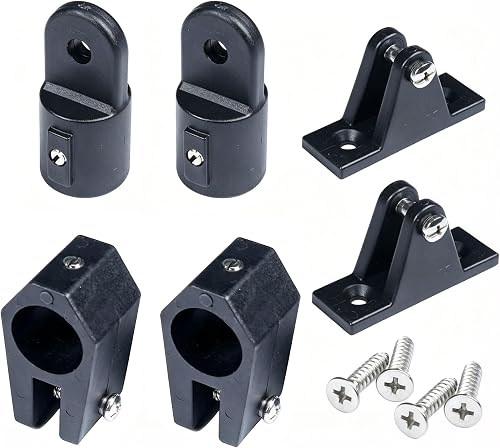
MX Boat Bimini Top Fitting Hardware Set Fit 7/8 inch Tubing 6PCS Nylon

2 Packs Bimini Top Deck Hinge with Pin and Ring and 4 Packs Pad Eye Straps, 316 Stainless Steel Bimini Boat Tops…
BarcoEquipado score: combines the average rating and the number of buyer reviews on Amazon. No brand pays to be featured.
The parts of a bimini frame
A bimini is a tube frame with a tensioned fabric top. Almost everything that fails is hardware: a jaw slide that works loose, a lost pin or a corroded hinge. Knowing the parts helps you order the right one, and the products above change with stock, so check the tubing size and material.
| Part | Function | What to check |
|---|---|---|
| Jaw slide | Joins two tubes and lets you fold or adjust the bow | Tube diameter and locking screw |
| Eye end | Caps the tube end and gives a fastening point | Eye with enough thickness |
| Deck hinge | Secures the frame to the deck and lets it fold down | Base and pivot angle |
| Rail mount | Attaches the frame to a rail or stanchion | Rail tube diameter |
| Quick-release pin | Removes the top without tools | Pin thickness and length |
| Straps and bracing | Tension the top and stop it flapping | Stainless buckle and quality webbing |
How to measure the tubing and choose the size
Bimini frames are almost always made of 7/8 in (22 mm), 1 in (25 mm) or 1 1/4 in (32 mm) tubing. To get it right:
- Measure the outside diameter with calipers, or wrap a tape around the tube and divide by 3.14.
- Check the wall thickness too: thin-wall tubing needs fittings with a bushing.
- Don't mix metric and imperial: 22 mm tube and a 7/8 in (22.2 mm) fitting match, but 25 mm tube will not fit a 7/8 in fitting.
- With the frame assembled, confirm the tubes overlap enough in the jaw slide: at least twice the diameter.
If you're replacing the whole frame or fabric, first look at the best bimini tops and the guide on how to measure a bimini.
Materials: 316 stainless or aluminum
Bimini hardware takes sun, salt water and constant vibration. So:
- 316 (A4) stainless: the best choice for load-bearing parts such as hinges, pins and fasteners. Type 304 works below deck but rusts outdoors (304 vs 316 stainless).
- Anodized aluminum: light, no iron rust, common in tubing and large fittings. Don't let it touch stainless without an isolator, or you'll get galvanic corrosion.
- Nylon and UV-stabilized engineering plastic: in end caps, bushings and guides. They degrade in sunlight, so replace them when you see cracks.
Warning: use fasteners of the same material as the part and, between aluminum and stainless, a nylon washer or anti-seize paste. This is the cause of most screws seized to the tube.
Installation and deck mounting
- Hold the assembled frame on the deck and mark each base position with the boat at rest and the tubes squared up.
- Check what is under each hole: backing, core or void. Bimini hardware takes strong side loads in wind.
- Fasten with A4 through-bolts, a backing plate and wide washers. Avoid self-tapping screws in unreinforced laminate.
- Seal the holes with butyl or polyurethane (marine sealants) so water can't get into the core.
- Fit the top, tension the straps and check that every point shares the load.
Tip: carry spare base caps and quick-release pins aboard. They're the parts that disappear when the top is folded in a hurry.
Maintenance and common mistakes
Before each season, check fasteners and jaw slides, lubricate moving parts with a marine lubricant and rinse the tubing with fresh water. If you take the top down for winter, store it in its cover (boat covers) and not folded damp.
- Buying a jaw slide without measuring the tube diameter.
- Mixing plain steel fasteners with stainless parts.
- Overtightening the clamp until the tube deforms: lock it without crushing.
- Mounting to unreinforced laminate without a backing plate.
- Leaving the bimini up in a storm: tops aren't designed for strong winds, and the hardware is the first thing to give.
For other small pieces of hardware, see also stainless hinges and latches.
Frequently asked questions
What tube size is a bimini frame?
Usually 7/8 in (22 mm), 1 in (25 mm) or 1 1/4 in (32 mm) tubing. Measure the outside diameter with calipers before buying jaw slides, eye ends or hinges so they fit without slop.
What is a jaw slide?
It is the fitting that joins two tubes of the frame and lets you adjust or fold the bow. It loosens with a locking screw. Choose 316 stainless in the same diameter as your tube.
Stainless or aluminum for bimini hardware?
316 stainless for load-bearing parts such as deck hinges and pins. Anodized aluminum is light and fine for tubing and large fittings, but isolate it from stainless with a nylon washer or anti-seize paste.
How do I mount a bimini to the deck without damaging the laminate?
Use A4 stainless through-bolts with a backing plate and wide washers, and seal every hole with butyl or polyurethane. On a cored laminate, fill the hole with epoxy to protect the core.