If you buy through our links, Amazon pays us a small commission at no extra cost to you. That’s how we keep the site running. How we choose.
Contents
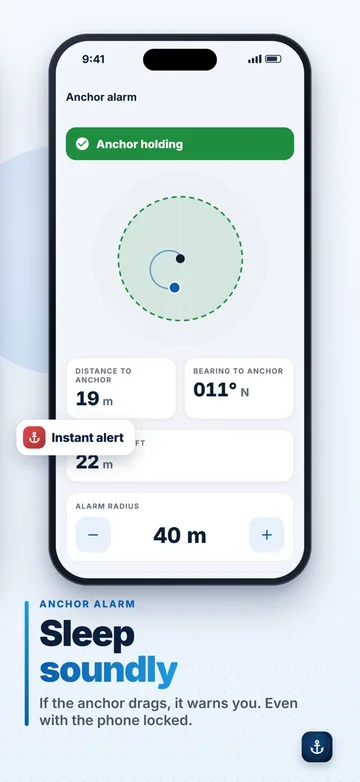
An anchor alarm app is only as good as its settings. Set the radius too tight and it wakes you every time the wind clocks around, until you switch it off for good. Set it too wide and it goes off when you are already on the rocks. Getting it right comes down to three things: where you mark the anchor, what radius you set and how you leave the phone for the night.
Short version: mark the anchor with the phone at the bow the moment the anchor hits the bottom. For the radius, use the horizontal distance of your rode plus your boat length plus 10-15 m (30-50 ft) of GPS margin. Keep the phone charging with the volume up, and test it before you go to sleep.
How to work out the alarm radius
The boat swings around the anchor, but not at the full length of rode you let out: part of it runs down to the bottom. When the wind stretches it out completely, the horizontal distance from the anchor to the bow is:
horizontal distance = √(rode² − height²)
where the height is the water depth plus your bow freeboard (from the bow roller to the waterline). Then add your boat length, because the phone is not on the bow roller but in the cockpit or the cabin, and a margin for GPS error.
Worked example
- Depth: 6 m (20 ft). Bow freeboard: 1 m. Height: 7 m.
- Rode let out: 35 m (a 5:1 scope).
- Horizontal distance: √(35² − 7²) = √(1225 − 49) = √1176 ≈ 34 m.
- Boat length: 10 m (33 ft). GPS margin: 10 m.
- Radius: 34 + 10 + 10 = 54 m. Round it up to 55 m, about 180 ft.
Notice that the square root only saves you about a meter: at 5:1 or more, the horizontal distance is almost the same as the rode let out. That is why the quick rule of "rode + boat length + margin" works well. The square root only matters when you anchor deep with short scope: with 33 m of rode in 10 m of water, the horizontal distance drops to about 31 m. If you are not sure how much rode you have out, start with our guide on how to anchor step by step.
Where and when to tap "Anchor here"
The alarm does not know where your anchor is. It saves the phone's position at the moment you tap the button and measures your distance from that point. That is why it matters so much where you are standing when you do it.
| When and where you mark it | Distance from point to anchor | Radius needed (example) |
|---|---|---|
| At the bow, as the anchor hits bottom | Almost zero | 34 + 10 + 10 = 55 m |
| At the bow, after the anchor has set | The horizontal distance (34 m) | 34 + 34 + 10 + 10 = 88 m |
| From the cockpit, after it has set | Horizontal distance + boat length (44 m) | 44 + 44 + 10 = 98 m |
If you mark it late, the saved point sits downwind of the anchor. As long as the wind holds steady, that is fine. But if it swings 180°, the boat ends up on the other side of the anchor and almost twice as far from the saved point. To avoid false alarms you would need nearly double the radius, and then the alarm takes far longer to warn you if you drag.
The most reliable method: take the phone to the bow and tap "Anchor here" the moment the anchor hits the bottom. Then pay out the rode, back down and check that it has set. If it does not hold and you have to try again, mark it again.
Anchoring on rope rode: nylon stretches under load. With a long section of rope, add a few extra meters to your margin.
How accurate is phone GPS?
Under an open sky, an iPhone's GPS is usually good to 3-5 m (10-15 ft). Down below, surrounded by fiberglass, metal and rigging, the error can grow to 10-20 m, and the position wanders even when the boat is not moving. That is where the 10-15 m margin comes from.
- Leave the phone near a port light or the companionway, not deep inside a cabin.
- Before you turn in, watch the distance to the anchor for a couple of minutes while the boat sits still: that spread is your real error.
- If the alarm goes off and the distance drops straight back to normal, it was probably a GPS jump. Add a few meters to the margin rather than taking them away.
Battery, locked screen and volume
Running GPS all night drains the battery. An iPhone may last until morning, but it is not worth the risk: keep it plugged in to a 12 V USB charger or a power bank. Make sure the cable will not work loose as the boat rolls.
- Locking the phone is fine if the app is built for it. What you must not do is swipe it away in the app switcher: iOS then stops giving it your location.
- Turn the volume up and check your Focus modes and Do Not Disturb so they do not silence the alert.
- Run a test once you are anchored: shrink the radius until the alarm sounds, make sure you can hear it from your bunk, then set the proper radius again.
- If you have crew, make sure someone else knows what the alarm means and where the phone is.
Wind shifts, swing circle and neighbors
Your alarm radius is also your swing circle: the space you take up when the wind changes direction. Before you trust the number, look around. Does that circle fit without touching rocks, shoals or other boats? Remember that your neighbors swing too, and not always the same way: a boat on rope rode moves farther and more slowly than one on all chain.
If you expect a wind shift during the night, such as a land breeze after an afternoon sea breeze, the alarm will tell you if you drag, but not that the boat next door has ended up too close. Only a good choice of spot fixes that.
What to do when it goes off
- Get on deck and look. Check the distance and bearing to the anchor on the screen and compare them with landmarks ashore.
- Has the wind shifted, or are you dragging? If the distance settles and the lights ashore are not moving relative to you, it may just be a wide swing or a GPS jump.
- If you are dragging: start the engine, wake the crew, turn on your navigation lights if needed and get ready to weigh anchor and reset it with more scope or somewhere else.
To pick an anchor that spares you nights like that, see the anchors we compared and our guide on which anchor you need.
Frequently asked questions
What radius should I set on my anchor alarm?
The horizontal distance of your rode (the square root of rode squared minus height squared), plus your boat length, plus 10-15 m of GPS margin. With 35 m of rode in 6 m of water and a 10 m boat, about 55 m (180 ft).
When should I mark the anchor position?
The most reliable way is to mark it with the phone at the bow the moment the anchor hits the bottom. If you mark it later from the cockpit, the point is far from the anchor and you need nearly twice the radius.
Does an anchor alarm work with the phone locked?
Yes, if the app is built for it, like Marine Tools. Do not swipe it away in the app switcher, keep the volume up and keep the phone charging.
Why does the alarm go off when I have not moved?
Usually because of GPS error below deck or a wider swing than you expected. Add a few meters to the margin and leave the phone near a port light.
You may also like
- GuideHow Much Anchor Chain to Let Out: Scope Explained With ExamplesHow to work out anchor scope: total height, 5:1 or 7:1, three worked examples with tide and wind, swing radius and anchor alarm.
- GuideAnchor Chain Weight by Size: kg/m and lb/ft ChartHow much 6, 8, 10, 12, 13 and 14 mm anchor chain weighs per meter and for 30, 50 and 70 m. DIN 766, ISO 4565 and G43, gypsy pitch and bow trim.
- GuideThe Rule of Twelfths: How to Work Out the Tide at Any TimeWhat the rule of twelfths is, how to use it step by step, and a worked example to check whether you will have enough water to get into harbor. Plus its limits.